Analytics Strategy
3 Levels of Analytical Knowledge, and Why They're Critical in Every Organization
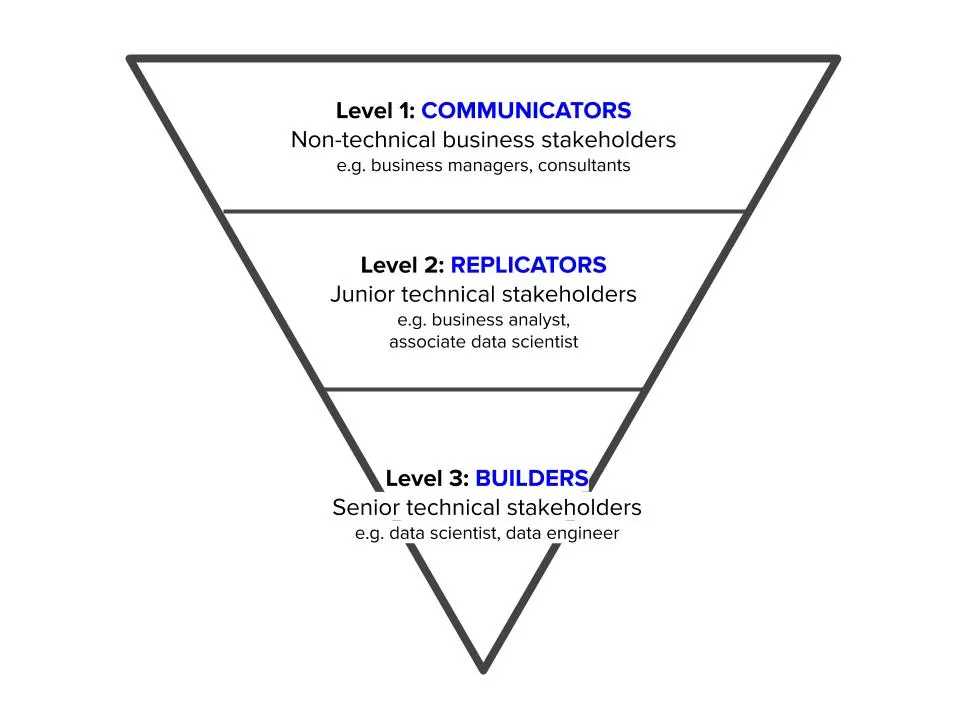
When dealing with technical subjects such as analytics, data science, or programming, individuals have varying depths of technical expertise. Employees with different levels of technical knowledge each play valuable roles within the "talent fabric" of an organization. However, it is important that all parties are aware of their level of expertise and understand where they fit within the business' collective knowledge base.
We've grouped employees into three tiers based on technical expertise: Communicators, Replicators, and Builders. For each group, we provide:
Who they are — describes the employees at that expertise level
Why they're critical — how each level provides distinct value
Where to master these skills — learning resources for reaching that level
Level 1: Communicators
Who They Are
As the name suggests, these individuals conceptually understand analytical processes or software without necessarily being able to execute them independently. Within consulting, these are often client-facing individuals who can articulate technical analysis at a high level while also bringing deep knowledge of the client's business or industry. This is why analytical consulting teams often deliver presentations with a Level 1 consultant (more involved in client engagement) paired with a Level 2 or Level 3 analyst (who can field deep technical questions).
Within corporations, Level 1 knowledge is equally valuable. Someone who can extract and communicate insights from a model or dataset is as valuable as the person who built it. Level 1 business stakeholders are often savvy in Excel and/or SQL, but their real strength is combining a base analytical understanding with a deep knowledge of business operations and strategy.
Why They're Critical
In consulting, having baseline analytical acumen is imperative. Whenever a consultant presents to a technical stakeholder, understanding the underlying data and calculations provides instant credibility.
Within corporations, these individuals bridge the gap between Analytics and Operations or Strategy. They are critical to building a data-driven culture — translating insights into decisions that non-technical leaders can act on.
Where to Master These Skills
Note: Course availability changes over time — verify current offerings on each platform.
Coursera | Business Analytics Specialization (Wharton) — covers Customer, Operations, People (HR), and Accounting Analytics
Coursera | Excel to MySQL: Analytic Techniques for Business (Duke/Airbnb) — advanced Excel, Tableau dashboards, and analytical approaches to strategic business problems
edX | Marketing Analytics Series (Berkeley) — includes Competitive Analysis & Segmentation, Price & Promotion, and Marketing Measurement
edX | Data Analysis with Excel (Microsoft) — extracting data insights using Excel
Tip: The "Excel to MySQL" specialization focuses on the tools used at Level 1, while the "Business Analytics" specialization focuses on the concepts. Both are worth your time.
Level 2: Replicators
Who They Are
Replicators conceptually understand given analyses and the underlying code that powers them. This skill set allows analysts to take pre-existing code and adapt it to new projects — without necessarily being able to build from scratch.
This group generally comprises more junior analysts. The value of reaching this level is significant: analysts learn best practices by working with more senior code. That said, when working with Level 2 analysts, it's important to provide coaching and quality assurance (QA) support. Mistakes at this stage are part of the learning process — and a necessary one.
Why They're Critical
Level 2 analysts have a multiplicative impact: once a set of analytical code exists, they can implement it across other projects. This dramatically compresses the time to execute an end-to-end analysis. When junior analysts can generate 80% of an analysis' outputs, senior analysts are freed up to do custom, technical, and QA work across multiple projects simultaneously.
Where to Master These Skills
Coursera | Data Science Specialization (Johns Hopkins) — a thorough introduction to the skills needed to become a data scientist
edX | Data Science with Python and R (Microsoft) — allows analysts to build proficiency in their preferred language
These courses provide solid instruction on data science principles without diving into the most technically advanced topics — ideal for someone transitioning into data science.
Level 3: Builders
Who They Are
These are your technical experts. They can start with a blank screen and build an end-to-end analysis or analytical product. This level of expertise can take years to achieve, and these analysts command relatively higher salaries. Importantly, not all Level 3 talent is the same — two key differentiators are conceptual competency and technical specialty.
Conceptual Competency is a requirement for any great analyst. It manifests in:
Understanding the business' current state and the implications of strategic or operational change
Considering multiple analytical approaches and pursuing the most elegant, robust solution
Writing dynamic, flexible code that doesn't require future manual adjustments
Building simple, scalable systems
Technical Specialty is the toolkit analysts bring. Common specialty areas include:
Area | Tools |
|---|---|
Data Extraction & Processing | Python, Ruby, Cloud IaaS, API Development |
Data Manipulation | SQL, Hadoop, Python |
Data Analysis | SAS, R, Python |
Data Visualization | Excel, BI tools (Tableau, Looker), R Shiny, D3.js |
Note that these specialty areas range in complexity, and Level 3 analysts may fall anywhere within each range.
Why They're Critical
These are your analytical innovators. They have the ability to add novel features to existing solutions — or build entirely new ones. They also tend to be the keepers of an organization's analytical best practices, establishing the statistical standards and methodologies used across all teams.
Because of this responsibility, Level 3 analysts typically hold at least a Master's degree in a quantitative field. Many top consultancies also have PhDs on their analytical teams.
Where to Master These Skills
Coursera | Master of Computer Science in Data Science (University of Illinois at Urbana-Champaign) — a fully online degree at a fraction of the cost of traditional programs
Berkeley | Master of Information and Data Science — available online, with a premium price tag reflecting Berkeley's brand and network
edX | Using Spark for Data Science Series (Berkeley) — five courses on different aspects of big data analytics, ideal for engineering-focused data scientists not pursuing a full Master's
Closing Thoughts
All three levels are essential to a high-functioning analytics organization. Builders create the analytical infrastructure; Replicators extend it across the business; Communicators translate it into decisions.
The most data-driven organizations don't just hire great data scientists — they build ecosystems where all three levels can thrive and collaborate effectively.
For more on the skills that bridge these levels, see: 4 Statistical Processes That Every Analyst Should Know.
The Data Strategist helps startups and scaleups become data-driven. Get a data scientist on-demand, or advice on building your analytical data stack.