Analytics Strategy
NPS Isn't Just a Vanity Metric — If You Use It Right
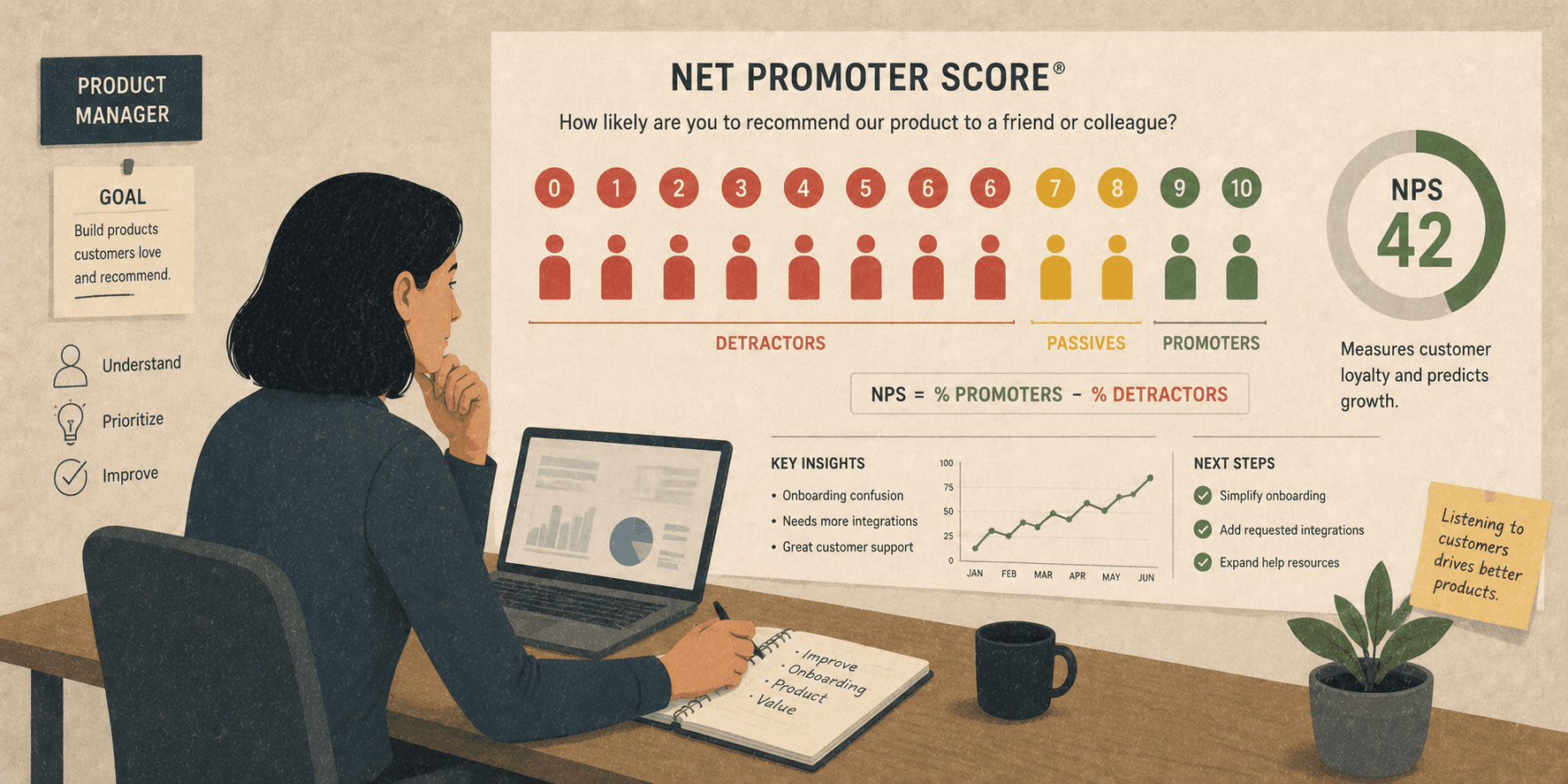
Most companies collect NPS. Very few know what to do with it.
Here's the pattern: a company sends an NPS survey. The responses come back. Someone in a product review says "we're at 42" and moves on to the next agenda item. The score gets dropped into a slide. The meeting continues.
This is how NPS becomes a vanity metric — not because the metric is inherently shallow, but because the team treats it that way. The number gets reported without being interrogated. It accumulates in a spreadsheet without influencing decisions. The score is present; the insight is absent.
But NPS used correctly is something very different. It's a leading indicator of behavioral change — one that can tell you why users are trending toward churning before they actually do it. It's a diagnostic tool for specific product features, not just the product at large. And paired with behavioral data, it's one of the few ways to understand the why behind what your metrics are showing.
The teams that use NPS well understand one thing that separates them from those who don't: the number is the starting point of the conversation, not the end of it.
What Happiness Metrics Are (And Why They're Different)
NPS belongs to a category called happiness metrics — metrics based on how users perceive your product rather than what they do in it.
Most of the metrics in any analytics stack are behavioral: Daily Active Users, session length, conversion rate, retention. These measure actions. Happiness metrics measure attitudes. They're distinct because they surface signals that behavioral data often can't explain.
Consider: retention falls 8% after a product update. Your behavioral data tells you that users are returning less frequently. But it doesn't tell you whether they left because the product got harder to use, because a competitor launched something better, or because a specific feature they depended on was removed. That's a very different decision set. NPS, especially when paired with open-ended qualitative follow-up, can begin to answer that question.
The key relationship between happiness and behavioral metrics: they should correlate. Users who score your product highly should be more likely to retain, expand, and refer. If NPS is rising but retention is falling, something is broken — either the measurement, the interpretation, or the product itself — and that divergence is worth investigating. The combination of both signals tells a more complete story than either one alone.
NPS vs. CSAT: What's the Difference?
These two happiness metrics are often conflated. They measure different things and serve different purposes.
CSAT — Customer Satisfaction Score asks: "On a scale of 1–10, how satisfied are you with our product?" The score is calculated as the simple average of responses. CSAT is best for measuring satisfaction with a specific interaction, feature, or moment in the user journey — a recent support ticket, a new checkout flow, a specific onboarding step.
NPS — Net Promoter Score asks: "On a scale of 0–10, how likely are you to recommend our product to a friend or colleague?" The phrasing matters. Willingness to recommend is a higher bar than satisfaction — it implies enough trust and enthusiasm to stake your own reputation on the endorsement. The score is calculated differently than CSAT:
Promoters (9–10): enthusiastic advocates, likely to refer others
Passives (7–8): satisfied but not enthusiastic enough to recommend actively
Detractors (0–6): dissatisfied or at-risk users, potentially harmful to brand reputation
NPS = (% Promoters − % Detractors) × 100
A worked example: if you survey 6 users and get 3 responses of 9 or 10 (Promoters), 2 responses of 7 or 8 (Passives), and 1 response below 7 (Detractor):
% Promoters = 3/6 = 50%
% Detractors = 1/6 = 17%
NPS = (50 − 17) × 100 ÷ 100 = NPS of 33
Scores range from −100 (all detractors) to +100 (all promoters). NPS above 50 is generally considered excellent; above 70 is exceptional. Below 0 is a clear signal that something is significantly wrong with the product or experience.
How to Collect NPS (In-App Beats Email)
The medium of collection shapes the quality of the data significantly.
Email surveys (Typeform, Google Forms, SurveyMonkey) have the advantage of being easy to set up and send. The disadvantages are meaningful: email open rates often fall below 10%, response rates are lower still, and the user responds from memory — sometimes days or weeks after their last product interaction. Memory degrades. The recency effect is a real distortion.
In-app surveys (Qualtrics, GetFeedback, Pendo) address these problems directly.
Recency: the user responds immediately after using the product, when their experience is fresh and their response reflects what they actually just felt.
Response rates: in-app prompts consistently outperform email surveys by a significant margin. Users are already engaged; the barrier to response is low.
Data integration: in-app responses can flow through your existing event collection pipeline directly into your analytics database. This makes it straightforward to join attitudinal data with behavioral data — the same user's NPS score alongside their retention pattern, their feature usage, their acquisition source.
Calendly offers a useful case study in done-right NPS collection. Rather than asking for NPS on the product as a whole, Calendly embeds targeted feedback directly into specific product flows — for example, after a user configures SAML-based sign-on. The survey pairs a usability question ("How easy was this to set up?") with a satisfaction question ("How satisfied are you with this feature?"). That pairing reveals whether difficulty of use is the driver of dissatisfaction — which shapes what the product team actually fixes.
Calendly also maintains a persistent feedback tab on the desktop interface, making it possible for users to share input at any time, not just when prompted. This creates a continuous signal rather than a periodic snapshot.
What's a "Good" NPS?
The most common mistake in benchmarking NPS is comparing your score to published industry averages without accounting for the massive variation in how NPS is collected and who is surveyed.
A company that surveys users immediately after a positive customer service interaction will have a very different NPS than one that surveys its entire user base, including users who haven't logged in for 90 days. These aren't comparable numbers.
A better benchmarking approach: survey your own users on both your product and the competitors they've used. This controls for individual response tendencies (some users score everything 8; others score everything 5) and for collection method biases. The delta between your score and your competitor's score, measured in the same survey from the same users, is a much cleaner competitive signal than any published benchmark.
App Store ratings offer another proxy: they're publicly available, they scale, and they can be converted to a comparable NPS-like range. Third-party platforms like App Annie and G2 provide aggregate review data that can serve a similar benchmarking function.
Four Ways to Use Happiness Metrics in Your Business
1. Business health indicator. Track NPS over time alongside behavioral KPIs — retention, engagement, conversion. When NPS and retention move in the same direction, the product is healthy. When they diverge — NPS rising but retention falling, or the reverse — you have a clear signal that something in the product experience is disconnected from its perception. That divergence is always worth investigating.
2. Feature performance indicator. NPS on the product as a whole tells you little about which parts of the product are driving the score. NPS on specific features — a new checkout flow, a redesigned settings panel, a new onboarding step — tells you where to focus. Calendly's targeted surveys are a model of this approach. The insight is much more actionable than an aggregate score.
3. Paired with behavioral data. If NPS rises after a feature launch but Day 30 retention declines, you're seeing a pattern: users like the new design, but something in the implementation is eroding long-term engagement. Load time, increased complexity, a broken workflow edge case. Behavioral data tells you what is happening; NPS helps you understand how users feel about it, which is often a clue to why.
4. Qualitative feedback collection. Always pair NPS scale questions with an open-ended follow-up: "What's one thing we could improve?" or "What nearly caused you to rate us lower?" The numerical score is the summary. The qualitative responses are the explanation.
Qualitative feedback from detractors is especially valuable — and especially overlooked. Detractors are telling you exactly what's wrong with your product. They're giving you a roadmap for the improvements most likely to convert them to passives or promoters. Ignoring them is leaving one of the most actionable research datasets you have on the table.
Common NPS Mistakes
Treating NPS as an annual event rather than a continuous signal. Product experience changes throughout the year; a score collected once annually is nearly useless for understanding those changes.
Surveying only active, happy users due to recency bias in your outreach list. If you only survey users who logged in this week, you're missing the perspective of users who are drifting toward churn.
Not segmenting NPS by customer type, tenure, acquisition channel, or plan tier. A 42 NPS that averages an 80 from enterprise customers and a 20 from SMB customers tells a very different story than a flat 42 across the board.
Ignoring detractors entirely, when they're the cohort most likely to churn — and the most willing to tell you why.
The Score Is Just the Starting Point
NPS isn't valuable because it gives you a number. It's valuable because it opens a conversation — with your data, with your users, and within your product team.
The best NPS practice triangulates: the quantitative score, the behavioral context (what are these users actually doing?), and the qualitative feedback (what are they telling you in their own words?). When all three align, you have a clear picture of product health. When they diverge, you have a clear research question.
Either way, you know something. That's the point.
The complete HEART metrics framework — Happiness, Engagement, Adoption, Retention, and Task Success — is covered in The Data Strategist course.