Revenue Intelligence
The Information Lifecycle: How a User Click Becomes a Business Decision
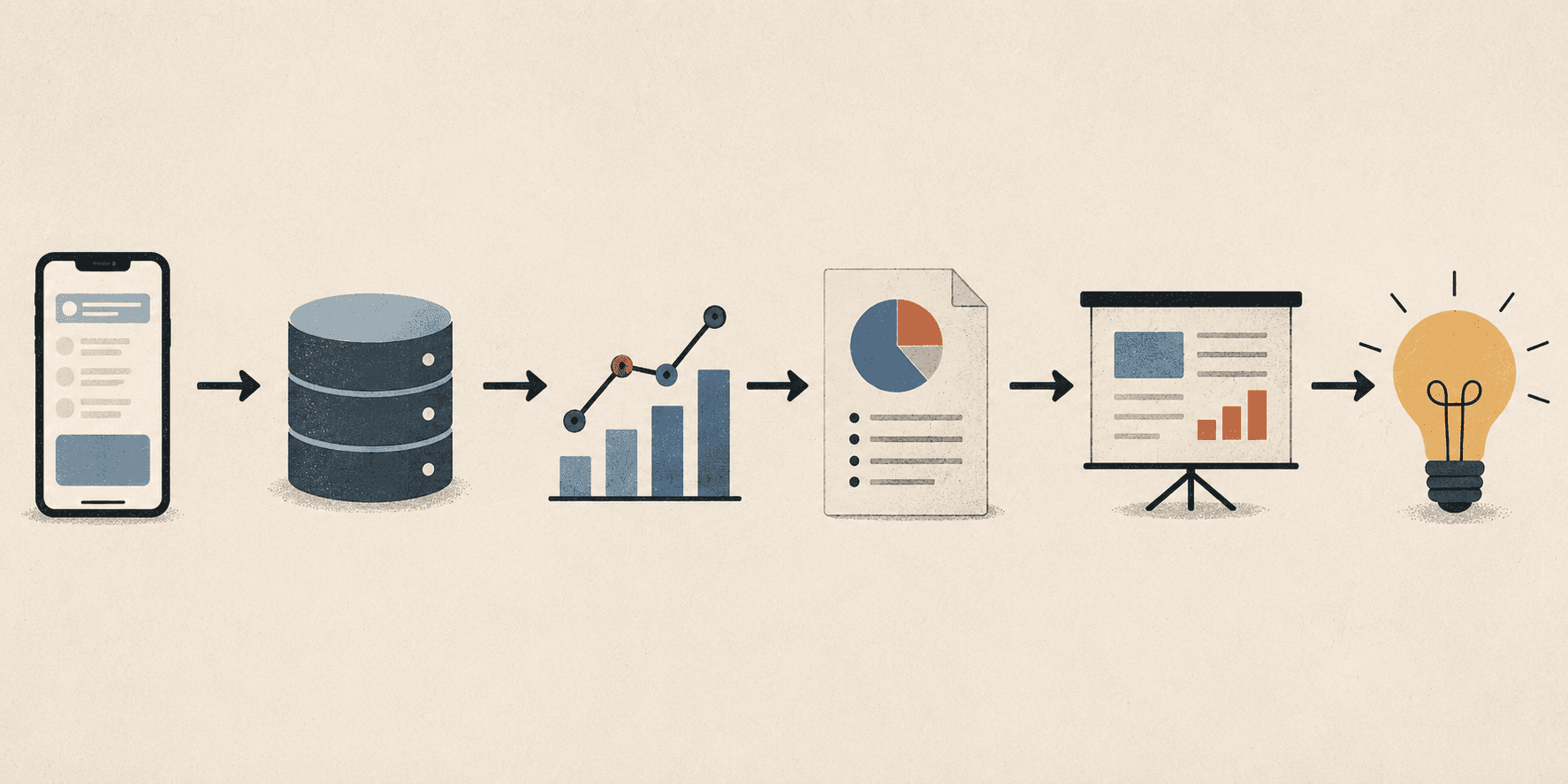
Most founders know data is valuable. Almost none can describe the full journey it takes to get there.
Imagine you're running Notion. A user opens the app, creates a new page, and starts typing. That action — quiet, invisible, over in seconds — will eventually make its way into a quarterly business review, shape a product roadmap, and influence decisions made by executives who will never interact with that user directly.
How? The answer is a seven-stage journey that most founders have never seen mapped end to end. Understanding it won't make you a data engineer. But it will make you a better partner to your data team, a smarter buyer of data tools, and a more effective leader.
This is the Information Lifecycle.
Stage 1: Events — Data's Moment of Inception
Everything starts with an event. An event is any action that can be tracked digitally: a page view, a button click, a registration, a transaction, an email open. When that Notion user created a new page, a code snippet logged an event called something like Page Created — and with it, a timestamp, a user ID, and a set of properties describing what happened.
Events come from two primary sources. The first is product instrumentation: tracking code that your engineers write and embed in your product. The second is SaaS integrations: third-party tools that generate their own events when users interact with them (think Stripe for payments, Twilio for SMS, or Intercom for support).
Here's why events matter so much: everything downstream is built on them. Your metrics, your reports, your analyses — they're all derived from events. If your events are incorrectly named, misdefined, or firing at the wrong moments, every downstream output inherits that error. Garbage in, garbage out isn't a cliché — it's a structural reality.
Stage 2: Data — Raw Information in the Database
Events land in a database as rows in a table. At this stage, the information is raw — unformatted, uninterpreted, not particularly useful to anyone except engineers and analysts who know how to write SQL.
Data can be classified by source. First-party data comes directly from your product — sessions, transactions, user behavior. Second-party data is derived: you calculate it from first-party data, like a user's lifetime value or a churn prediction score. Third-party data comes from external vendors: demographic enrichment, competitor benchmarking, market signals.
Most early-stage startups start with first-party data and layer in third-party sources as they scale. Tools like Google Analytics, Amplitude, and Segment help collect and route event data. Fivetran and Airbyte help consolidate it. BigQuery and Snowflake store it. At this stage, the data is real and it exists — but it isn't yet telling anyone anything useful about the business.
Stage 3: Metrics — The First Business-Readable Form
Metrics transform raw data into something the business can understand and act on. A metric quantifies a trend or performance dimension: Weekly Active Users, Day 7 Retention, Revenue per Visit, Average Order Value. For the first time in the lifecycle, a non-technical person can look at the output and understand what it represents.
Every team in the organization tracks metrics tied to its goals. Notion's product team might track feature adoption and session depth. The growth team tracks acquisition and activation. The content team tracks time-on-page and newsletter signups. Each team's metrics connect to its objectives — what the data strategy world calls OKRs.
Think of metrics as the vital signs of your business. They're like the monitor above a hospital bed: they tell you whether the patient is stable, improving, or in distress. But just like hospital vital signs, they require context to interpret correctly. A heart rate of 100 bpm means different things for a marathon runner mid-race and a patient at rest.
Stage 4: Reporting — Structure and Context
Reports take metrics and organize them into something with narrative structure. A weekly growth report, a quarterly board deck, a live dashboard — these are all forms of reporting. They add context: trend lines, comparisons against prior periods or benchmarks, annotations explaining notable changes.
Reporting broadcasts vital signs to the entire organization, not just to the analyst who queried the database. When a Notion executive opens the Monday morning business review, they're consuming a report. When a product manager pulls up the retention dashboard before a roadmap meeting, they're consuming a report.
But here's the important limitation: reporting can tell you what happened. It cannot tell you why. Revenue dropped 12% in Q3. Session depth declined 8% after the last release. Pages created per user fell three weeks in a row. Reports surface these facts. They do not explain them.
That requires the next stage.
Stage 5: Analysis — Combining Data with Business Knowledge
Analysis is where data meets judgment. It's the process of bringing qualitative business context to quantitative signals — forming a hypothesis about why something happened, then testing it against the data.
In practice, this looks like a team identifying a "known unknown" — a question they know they don't have the answer to — and then partnering with a data scientist or analyst to investigate it. Why did activation rates drop for mobile users in Southeast Asia? Is the decline in Day 30 retention driven by users who signed up via paid acquisition or organic search? What's causing the divergence between engagement in the US and Europe?
Analysts often partner with user researchers at this stage. Behavioral data — what users do — is enriched by attitudinal data — what users say about why they do it. A survey, a set of user interviews, or a support ticket analysis can add color that the database alone can't provide.
The output of good analysis is two things: an answer to the guiding question, and a set of insights that stand on their own.
Stage 6: Insights — Standalone Statements of Value
An insight is a standalone statement that captures something true and useful about the business — something you didn't know (or couldn't quantify) before. It's the distilled output of analysis.
What makes an insight valuable is that it's actionable. Not "Q3 revenue declined" (that's reporting). Not "Q3 revenue declined because of lower conversion rates" (that's still reporting, with more context). An insight sounds like this: "Mobile users who complete onboarding in under three minutes have 2.4x higher 90-day retention than those who take longer — suggesting that onboarding friction is the primary driver of early churn."
Insights can also be unexpected. You set out to analyze a known unknown and discover an unknown unknown — something you didn't know you didn't know. A team investigating pricing sensitivity might discover that a completely different variable — geographic delivery time — is the stronger predictor of repeat purchase. That discovery becomes an insight that can reshape the product roadmap.
This is the highest-leverage output in the entire lifecycle.
Stage 7: Knowledge — The Compound Interest of Insights
Knowledge is what you get when you accumulate insights over time. It's a unified understanding of a business domain — built insight by insight, validated and refined through repeated analysis.
One insight can be wrong. Two conflicting insights create a question. Ten consistent insights, tested under different conditions, begin to form a reliable picture. That picture is knowledge.
The challenge is distribution. Knowledge is only valuable if it's accessible. How does the insight discovered by the data team in Q2 make it into the product review in Q3? How does the finding from a user research study influence the next growth experiment? Organizations that invest in knowledge management — documented, searchable, and actively shared — compound their advantages over time. Organizations that don't keep rediscovering the same things.
The Key Principle: Downstream Quality Is Bounded by Upstream Quality
Here's the most important thing to understand about this lifecycle: each stage depends entirely on the quality of the stage before it.
If events are incorrectly instrumented, your metrics will be wrong. If your metrics are poorly defined, your reports will mislead. If your reports are unreliable, your analysis will start from a flawed premise. If analysis is flawed, your insights won't hold up. And if insights don't hold up, knowledge never accumulates.
The implication is practical: investment in upstream quality — clean event instrumentation, precise metric definitions, reliable data infrastructure — has compounding returns. It's not glamorous work. It rarely makes it into a pitch deck. But it determines the ceiling of everything that comes after.
What This Means for You
You don't need to build this entire lifecycle before you make your first hire or ship your first feature. Most early-stage startups are somewhere in the middle of this map, and that's fine.
But knowing the map exists lets you ask better questions. When your analyst delivers a report, you can ask: what events is this built on, and are we confident they're firing correctly? When a metric changes unexpectedly, you know to push from reporting toward analysis. When a data tool gets evaluated, you can situate it within the lifecycle and understand what stage it serves.
The founders who build data-driven companies aren't necessarily the ones who know the most SQL. They're the ones who understand how information flows — and who invest in each stage before expecting returns from the next one.
Want to understand the full data strategy stack — not just the lifecycle, but how to build it at your company? The Data Strategist course covers every layer, from events to organizational design.