SmartBid: AI-Powered Upwork Job Intelligence
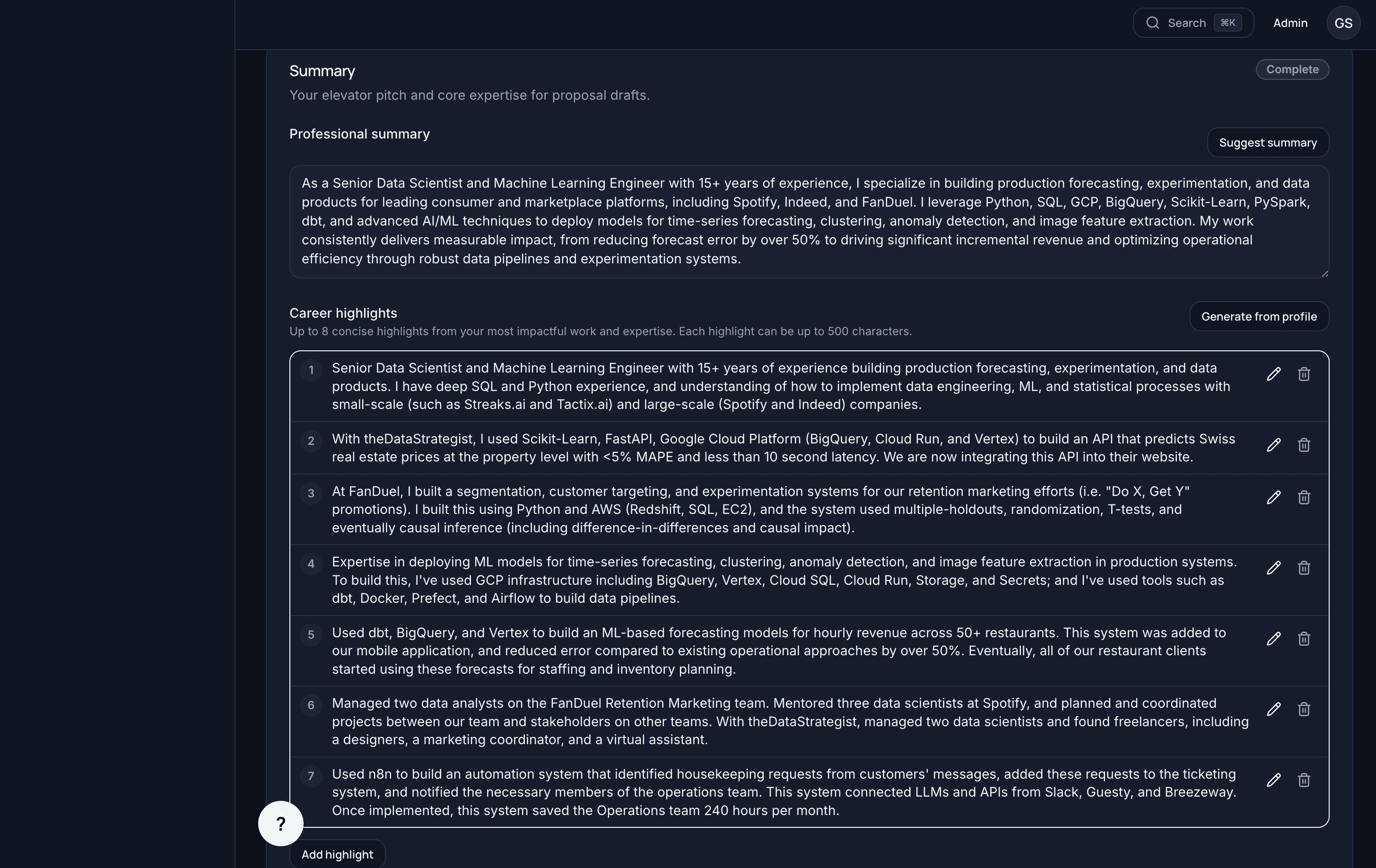
A human-in-the-loop platform that scores Upwork jobs across quality, competition, employer, and fit signals — built as an applied AI/ML portfolio project.




OVERVIEW
Helping Freelancers Decide Before They Write
SmartBid is an AI/ML learning project built as a real product: a marketplace intelligence platform that helps freelancers decide which Upwork jobs are actually worth applying to. The problem is simple — freelancers spend too much time guessing — and the answer is measurement, not automation.
The platform analyzes each job opportunity across five signals: job quality, competition, employer quality, employer engagement, and personal fit. It then supports the freelancer with an LLM-assisted proposal draft they review, edit, and submit themselves.
The goal is not to automate the freelancer out of the process. It is to help them apply better judgment before they spend time writing a proposal.
The Challenge
Freelancers on Upwork face a noisy, competitive marketplace with almost no decision support:
Hundreds of new job posts a day, with no reliable way to judge which are worth pursuing
No visibility into competition levels or an employer's hiring track record
Proposal writing is slow, so every bad application is expensive
Generic AI auto-apply tools violate platform rules and produce spam, not signal
The product challenge was to build ranking and scoring that a freelancer can trust — explainable, compliant with Upwork's Terms of Service, and always leaving the human in control.
APPROACH
The Approach
I designed and built SmartBid end to end as a compliance-first, human-in-the-loop product:
A scoring framework that rates every job on quality, competition, employer quality, employer engagement, and personal fit (Job Fit Score)
Analytics pipelines in BigQuery and dbt that turn raw job and employer data into the marts behind each score
An LLM-assisted drafting workflow on Vertex AI that generates personalized proposal drafts from the freelancer's profile and onboarding answers
Prompt contracts with versioning and evaluation, so generation behavior is deterministic and inspectable rather than a black box
Explainable recommendations: every score surfaces the context behind it, so the user understands the why, not just the number
Strict non-goals: no auto-submission, no scraping, no stored Upwork credentials — official API only, and the freelancer submits every proposal manually
Core architecture:
Next.js web application for job discovery, scoring views, and proposal drafting
PostgreSQL for application data; BigQuery as the analytical warehouse
dbt marts powering the scoring framework and job insights
Vertex AI for the proposal-generation pipeline, with versioned prompt contracts
Upwork's official GraphQL API as the sole, read-only data source
Separate dev and prod environments on Google Cloud Platform with validated deployments
Tiered Free / Starter / Pro subscription model with entitlements and paywalls
Technical Stack
Vertex AI
BigQuery
dbt
Next.js
PostgreSQL
Python
Upwork API
Google Cloud Platform
RESULTS
Key Outcomes
A working end-to-end marketplace intelligence platform, from data ingestion to scored job feed to AI-assisted drafts
Five explainable scoring signals covering job quality, competition, employer quality, employer engagement, and personal fit
A BigQuery/dbt analytics layer with documented metrics specs and dbt marts
A prompt versioning and evaluation workflow for the LLM drafting pipeline
A compliance-first design: official API only, read-only, human control at every step
Why This Matters
SmartBid is primarily a learning vehicle for how real marketplace intelligence products work — ranking and scoring systems, analytics pipelines, LLM workflows, and human-in-the-loop product design. Building it as a genuine product, with real constraints, made the lessons concrete:
Ranking is a product problem as much as a modeling problem: scores must be explainable to be trusted
Compliance constraints (official APIs, no automation) shape the architecture, not just the legal page
Prompt versioning and evaluation turn LLM features from demos into dependable product surfaces
One principle kept recurring: AI products are more interesting when they help people apply better judgment, not bypass judgment entirely.
Looking Forward
Planned next steps:
Personalized job notifications and saved-search alerts
Job tracking and outcome insights (interviews and contracts won)
Profile optimization recommendations
Richer personalization from like/dislike/save signals in the job feed
An expanded evaluation harness for prompts and scoring quality
Interested in building something similar?
We help organizations design scalable AI and analytics infrastructure for:
forecasting
growth analytics
operational automation
machine learning platforms
agentic AI workflows
cloud-native data systems
Let’s build systems that turn data into operational leverage.
